Field note 01 · Notes / Field notes
Two models.
One brief.
Two pagodas.
The same creative task, given to a frontier model in the cloud and to a local model on one laptop. GPT-6.1 Sol in the cloud finished in under 10 minutes. A 4.7-bit Qwen model on a single MacBook Pro took 63 minutes and passed the same checks. Both first versions failed QA, and both passed after one repair.
01The gardens
Two finished worlds.
Judge them yourself.
Both are the finished, accepted versions. In either world, drag to orbit, scroll to zoom, and switch between day and dusk. Sol has a Reset button; reload Qwen to return to its starting view. Each opens as a standalone page; use your browser's Back button to return here.
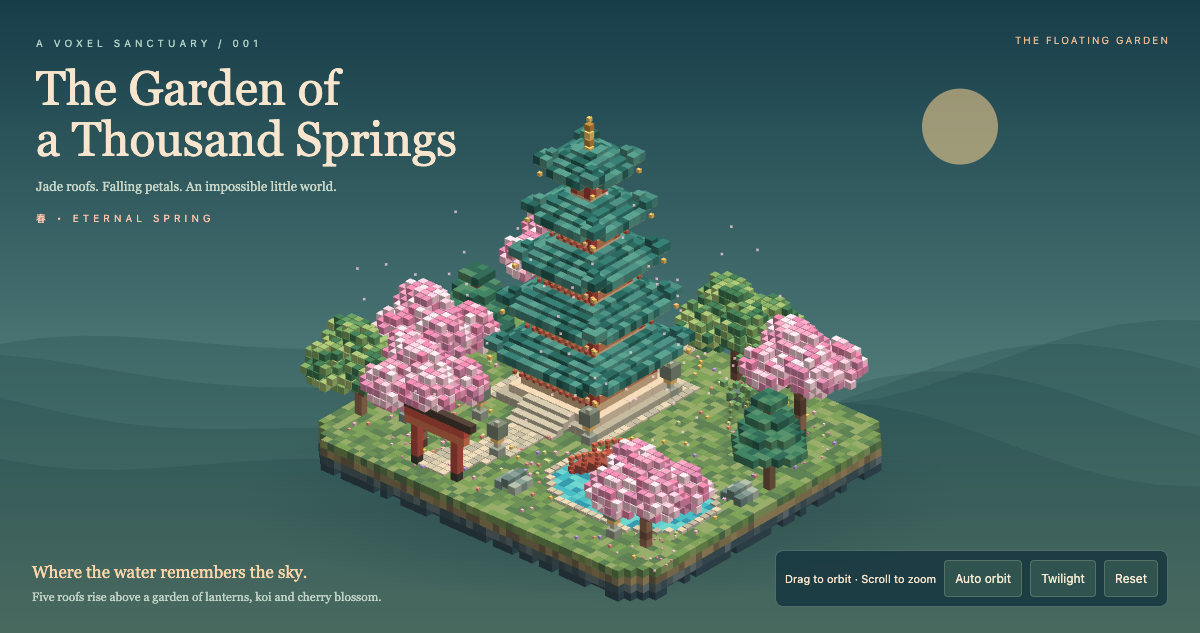
Cloud builder01 / 02
GPT-6.1 Sol (OpenAI, cloud)
A richly layered garden with jade rooftops, lanterns and drifting petals. Drawn with the browser's Canvas, with no outside libraries.
Explore Sol's garden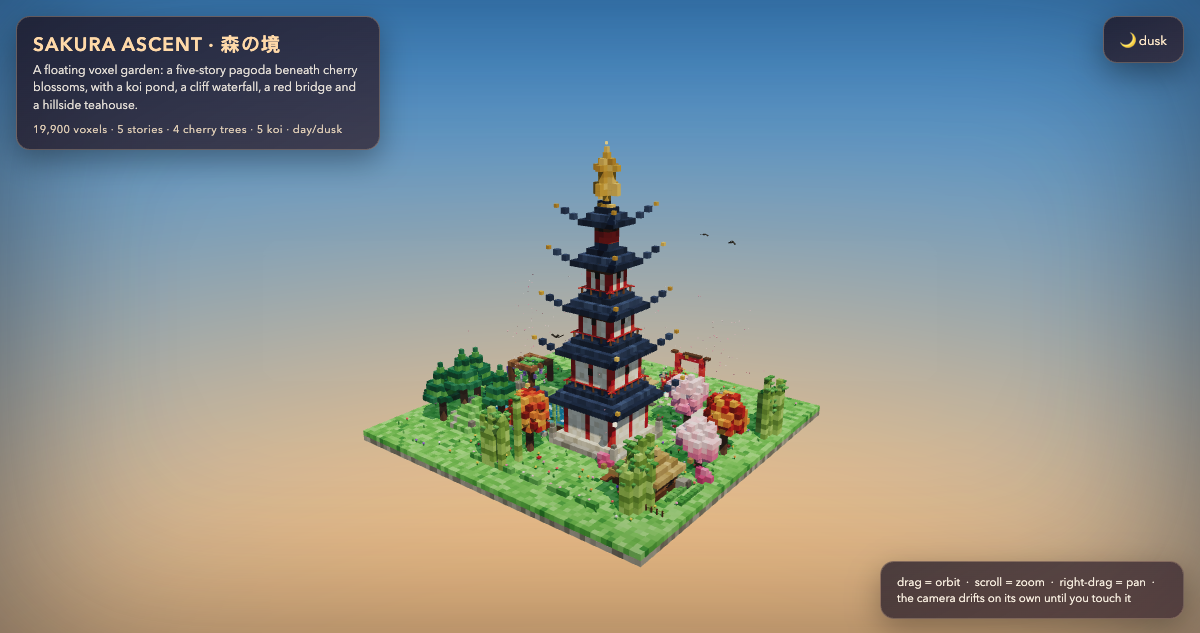
Local builder02 / 02
Qwen3.8 Flash Next, 4.7-bit MLX (local)
A soaring pagoda set in a bright, spacious garden of blossoms. Drawn with WebGL through Three.js.
Explore Qwen's gardenAbout the demos. Both demo files are unedited model output, exactly as each builder submitted them, so they may contain US spelling or dashes. Qwen's demo loads Three.js (MIT licence) from the unpkg CDN, so it needs an internet connection. Sol's demo needs nothing outside its own file.
02The story
Same brief.
Same checks.
The original ask was simple: make a creative, elaborate voxel art pagoda in a colourful garden with trees and cherry blossoms, all in one HTML file.
Design and create a very creative, elaborate, and detailed voxel art scene of a pagoda in a beautiful garden with trees, including some cherry blossoms. Make the scene impressive and varied and use colorful voxels. Use whatever libraries to get this done but make sure I can paste it all into a single HTML file.
- 01
Make it
Each builder independently made a first version from the same brief.
- 02
Look closely
Browser checks failed both first versions.
Sol: face gaps appeared when the scene was rotated. Qwen: clouds blocked the pagoda, and the default framing and UI did not pass.
- 03
Repair, then explore
Each builder got one factual feedback handoff in a fresh session. Both revised versions passed the same acceptance checks. The evaluator did not edit either scene.
03The clock
The time it took.
Recorded builder runtime for the first build plus its repair. A longer bar means more elapsed time, not worse art.
About 6.5× the elapsed builder time for Qwen on this one task. That is a runtime comparison, not a quality score.
| What happened | GPT-6.1 Sol (OpenAI, cloud) | Qwen3.8 Flash Next, 4.7-bit MLX (local) |
|---|---|---|
| First build | 5m 17s | about 43m 29s |
| First visual check | Did not pass | Did not pass |
| Repair | 4m 27s | 19m 28s |
| Final visual check | Passed | Passed |
| Total builder runtime | 9m 44s | 62m 57s |
| Submissions / repairs | 2 / 1 | 2 / 1 |
| Evaluator scene edits | 0 | 0 |
04Practical fit
Different jobs.
Different tradeoffs.
Frontier when time matters.
For a supervised build with someone waiting on the result, the shorter observed runtime made Sol the practical choice on this task.
Local when waiting is fine.
For work that can run in the background on hardware you already own, that runtime is acceptable and the result was usable.
The build itself ran on local hardware. The orchestration and review around it were frontier-assisted, so this was not an end-to-end local or private workflow. Background queues, overnight runs, cost and throughput were not tested.
05Limits and method
What this does
not tell us.
One unblinded creative task, not a general test of which model is better.
Both builders received the same brief, restrictions, time ceilings and visual acceptance checks: up to 45 minutes for the first build and up to two 20-minute repairs. Each used one repair. The repair was a fresh-session handoff, not an ongoing chat. The demos above are those final submissions.
Both builders worked inside an offline sandbox with no internet access, so neither could test in a browser; Qwen's choice of a CDN-hosted Three.js was therefore written blind.
Sol ran as a cloud model. Qwen ran locally on Ramforge's own MacBook Pro M5 with 128 GB unified memory: one laptop, not a Mac Studio or a cluster. Their configured inference, reasoning and hardware differed. This was one sample per builder, and the visual review was not blind. Sol's demo uses browser Canvas; Qwen's uses WebGL and loads Three.js from a CDN, so Qwen's demo needs internet access.
Times include builder tool use, but exclude setup and independent visual QA. Labour time, cost, tokens and frame rate were not measured. Read the clock as an observation about this particular build, not a prediction for every project.
Exact model labels and method notes
- Sol
openai/gpt-6.1-sol- Qwen
mlxserve/ddalcu/Qwen3.8-Flash-Next-MLX-Serve-iQ-MLX-4.7bpw
Both started from the prompt above and delivered single-file HTML scenes. A separate browser review checked default framing and interactive controls at desktop and narrow viewports, then supplied factual feedback for one model-authored repair each. No evaluator-authored scene changes were made.